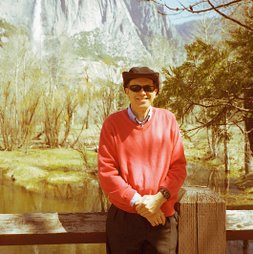
When I was in the Cub Scouts, my family went to Yosemite the first time. My parents bought me a Brownie Hawkeye camera made by Kodak, and soon I was an avid amateur photographer. When someone offered to finance a trip to the Holy Land for me, I bought my first camera with interchangeable lenses. One of those lenses was a wide-angle lens, and for some reason it became my favorite. A few years later, I was part of a monthly color slide competition, and most of the submitted slides winning ribbons were taken with that wide-angle lens.
Looking back, it appears that looking through the wide-angle lens had an effect upon how I see life. That applies to life on earth as well as possibly on other planets. While most people see their lives on an hour-by-hour or day-by-day basis, I tend to see things more broadly, seeing our country’s progress in terms of decades, and seeing the larger church in the same way. On my second anniversary here next September, I will probably be comparing the two years more than looking at month-to-month progress.
When I was a younger adult, I looked at my professional and spiritual life in terms of 3-5 year blocks of time. It has been a little over a half century since I confessed my faith in Christ and was baptized. It is amazing at how patient God has been with me. There have been many things for which it has been necessary to seek forgiveness. God’s grace and mercy are amazing. I hope that I keep growing and improving.
God has given me a profession that continues to be challenging and fulfilling. Re-examining my example set for others, I am looking for examples that our leaders can provide that will lead to further growth. We plan to establish our congregation’s web page on the internet during this coming month. Other congregations testify to the fact that their internet presence creates more visitors and new members.
Since God gave me a novel to write, now it is in the marketplace for the critics to cross-examine. As I am writing this, someone on the internet that I have never met has inquired regarding the address of my blog which shares my faith. My novel serves as a springboard for conversation there. I hope conversations will start here as well.
Showing posts with label Christianity. Show all posts
Showing posts with label Christianity. Show all posts
Saturday, January 31, 2009


Saturday, January 24, 2009
Alien Love
My novel, Aliens Are God's Children Too, explores may issues in life. Yes, it is science fiction. It also has Christian themes infused into it. It is also a romance. It explores love as expressed by creatures on other planets. It also explores the idea of how God's love might be expressed through intelligent life on other worlds.
"Love never ends," says 1 Corinthians 13:8a (NRSV). To put it another way, “Love is eternal.” Scientists talk about infinite things. Mathematicians use infinity as a device in doing a number of critical calculations. When scientists and mathematicians talk about infinity however, it is an incalculable distance or amount within our created universe. The human mind hardly comprehends the infinite in any useful way outside of science and mathematics. This is not a new challenge.
An eon is a stretch of time so long that no one can fathom it. Plato, a few years before the birth of Christ, coined a new word: aionios. What he literally meant was eternity. Eternity means having no beginning and no end, no change and no decay. Whereas an eon means indefinite time you cannot measure, eternity has nothing to do with time or anything measured. There is nothing created or destroyed in eternity. There is no past, present, or future. Eternity can only be applied to God.
The Greek word used in the New Testament which we translate eternal literally means without time, growth, past, present, or future. There are two areas where this word eternal is used in the New Testament. First, it is used in terms of covenant. When God makes a covenant with us, it has a beginning but has no end: Time is literally meaningless as far as God’s covenant is concerned, and that covenant cannot be destroyed.
The other way that the New Testament uses eternal with is hope. Our hope is eternal. The idea of eternal life is crucial to Christian faith. It is fundamental to our understanding of who Jesus Christ is, who God is, and how God works.
I am not one to do statistics of the Bible very often, but I have been fascinated by what I have learned about the word eternal. Eternal is coupled with a number of different words one to three times – except for one word. Eternal is coupled with life – eternal life – forty-four times. It makes us stop and realize how crucial the concept of eternal life was to the early church. It predominates the writing of John, of the Apostle Paul, and of all writers of the New Testament. How many times do we read, “His steadfast love endures forever" in the Psalms? Notice this word steadfast. It is coupled with dozens of different words in the Old and New Testament, but steadfast is coupled with love dozens of times. Love is constant. That brings us right back to the statement of the Apostle Paul in the eighth verse of I Corinthians: Love never ends. Love is steadfast. Love endures forever. We can really celebrate the ultimate source of the love that we receive from our mothers and fathers, for all love comes from God.
Once we acknowledge that idea and assimilate it into our minds, then we begin to get a feel for how much our God loves us. Moreover, we get a feel for how important it is to let God’s love flow through us, that others might see God's love in us. Love is patient and kind. Love is not jealous or boastful, nor is it arrogant or rude. It does not insist on its own way. Love is not irritable or resentful. Love does not rejoice at wrong, but love does rejoice in the right. Love does bear all things. Love does believe all things. Love does hope all things. Love does transform all things with triumphant fortitude. Love never ends. Indeed!
"Love never ends," says 1 Corinthians 13:8a (NRSV). To put it another way, “Love is eternal.” Scientists talk about infinite things. Mathematicians use infinity as a device in doing a number of critical calculations. When scientists and mathematicians talk about infinity however, it is an incalculable distance or amount within our created universe. The human mind hardly comprehends the infinite in any useful way outside of science and mathematics. This is not a new challenge.
An eon is a stretch of time so long that no one can fathom it. Plato, a few years before the birth of Christ, coined a new word: aionios. What he literally meant was eternity. Eternity means having no beginning and no end, no change and no decay. Whereas an eon means indefinite time you cannot measure, eternity has nothing to do with time or anything measured. There is nothing created or destroyed in eternity. There is no past, present, or future. Eternity can only be applied to God.
The Greek word used in the New Testament which we translate eternal literally means without time, growth, past, present, or future. There are two areas where this word eternal is used in the New Testament. First, it is used in terms of covenant. When God makes a covenant with us, it has a beginning but has no end: Time is literally meaningless as far as God’s covenant is concerned, and that covenant cannot be destroyed.
The other way that the New Testament uses eternal with is hope. Our hope is eternal. The idea of eternal life is crucial to Christian faith. It is fundamental to our understanding of who Jesus Christ is, who God is, and how God works.
I am not one to do statistics of the Bible very often, but I have been fascinated by what I have learned about the word eternal. Eternal is coupled with a number of different words one to three times – except for one word. Eternal is coupled with life – eternal life – forty-four times. It makes us stop and realize how crucial the concept of eternal life was to the early church. It predominates the writing of John, of the Apostle Paul, and of all writers of the New Testament. How many times do we read, “His steadfast love endures forever" in the Psalms? Notice this word steadfast. It is coupled with dozens of different words in the Old and New Testament, but steadfast is coupled with love dozens of times. Love is constant. That brings us right back to the statement of the Apostle Paul in the eighth verse of I Corinthians: Love never ends. Love is steadfast. Love endures forever. We can really celebrate the ultimate source of the love that we receive from our mothers and fathers, for all love comes from God.
Once we acknowledge that idea and assimilate it into our minds, then we begin to get a feel for how much our God loves us. Moreover, we get a feel for how important it is to let God’s love flow through us, that others might see God's love in us. Love is patient and kind. Love is not jealous or boastful, nor is it arrogant or rude. It does not insist on its own way. Love is not irritable or resentful. Love does not rejoice at wrong, but love does rejoice in the right. Love does bear all things. Love does believe all things. Love does hope all things. Love does transform all things with triumphant fortitude. Love never ends. Indeed!
Wednesday, January 7, 2009
Winter
OF WINTER STORMS
© 2002
The stormy winds, they blow so cold, our eyes can't see the sky.
We walk about with bodies numb — sometimes we think we'll die.
We concentrate on simple tasks, survival is our mode:
We want to do the basic things, not take on heavy loads.
We know from life's experience that storms do pass on by,
And when they've passed we might enjoy a clear and cheery sky.
We seldom think of dangers past, our lives are filled with now.
Deliverance is just accepted, no "I wonder how . . . ?"
And then there's times when danger's huge, and slaps us in the face!
We’re simply overwhelmed with pow'r, — --our ego's been displaced!
We’re stunned and humbled, weak and scared, we lift our voice on high,
The Power's holy presence brings a peace, and then a sigh.
So You and I are not alone, we look to God above.
Our God is watching over us, so constantly with love!
So in God's love we have no fear, for we can know God's Son;
And we can know redeeming grace, — our stormy battles' won!
© 2002
The stormy winds, they blow so cold, our eyes can't see the sky.
We walk about with bodies numb — sometimes we think we'll die.
We concentrate on simple tasks, survival is our mode:
We want to do the basic things, not take on heavy loads.
We know from life's experience that storms do pass on by,
And when they've passed we might enjoy a clear and cheery sky.
We seldom think of dangers past, our lives are filled with now.
Deliverance is just accepted, no "I wonder how . . . ?"
And then there's times when danger's huge, and slaps us in the face!
We’re simply overwhelmed with pow'r, — --our ego's been displaced!
We’re stunned and humbled, weak and scared, we lift our voice on high,
The Power's holy presence brings a peace, and then a sigh.
So You and I are not alone, we look to God above.
Our God is watching over us, so constantly with love!
So in God's love we have no fear, for we can know God's Son;
And we can know redeeming grace, — our stormy battles' won!
Friday, January 2, 2009
Christian business
Each January most of us find occasion to shout, "Happy New Year!" Is your new year really happy? Do the peace and joy of the little Christ child still linger with you throughout the year? Or do you go back to business is usual after Christmas is over?
It is amazing how each year people go to such elaborate means to prepare for Christmas, and then the day after Christmas they return from the mountain-top experience back to the valley of the shadows at the rate of a dive bomber. Why is it so few people linger at or near the top, and why not come down at a more leisurely pace? True, some of us leave the decorations up until after New Year's Day, but why does talk of peace and joy and good will all stop on December 26th?
The answer to these questions is found in the seventeenth chapter of the gospel according to Matthew. Jesus, along with Peter, James, and John, go up on top of a mountain. There the disciples see Jesus transfigured before them. That particular vision is perhaps one of the greatest experiences those men had in all their lives up until that time. Peter wanted to preserve the event, and he offered to build "booths" there -- a kind of monument. Immediately Jesus led them back down the mountain! Jesus went back to work -- business as usual -- and healed an epileptic.
Peter, James, and John had to come down off the mountain and return to the valley of the shadows, but remember: Jesus came down the mountain with them. While it is true that on Christmas we have an intense awareness of the Christ-child in our midst, much like seeing a transfiguration, Jesus is just as much with us on the day after Christmas. When the decorations are down we just have to have a keener awareness to notice Jesus' presence.
So it is back to "business as usual" -- back to the valley of the shadows -- after Christmas. For those who have the eyes to see, the peace and joy and good will can linger. It just could be that we should consign our bodies to the valley, but let our hearts linger on the mountaintop!
It is amazing how each year people go to such elaborate means to prepare for Christmas, and then the day after Christmas they return from the mountain-top experience back to the valley of the shadows at the rate of a dive bomber. Why is it so few people linger at or near the top, and why not come down at a more leisurely pace? True, some of us leave the decorations up until after New Year's Day, but why does talk of peace and joy and good will all stop on December 26th?
The answer to these questions is found in the seventeenth chapter of the gospel according to Matthew. Jesus, along with Peter, James, and John, go up on top of a mountain. There the disciples see Jesus transfigured before them. That particular vision is perhaps one of the greatest experiences those men had in all their lives up until that time. Peter wanted to preserve the event, and he offered to build "booths" there -- a kind of monument. Immediately Jesus led them back down the mountain! Jesus went back to work -- business as usual -- and healed an epileptic.
Peter, James, and John had to come down off the mountain and return to the valley of the shadows, but remember: Jesus came down the mountain with them. While it is true that on Christmas we have an intense awareness of the Christ-child in our midst, much like seeing a transfiguration, Jesus is just as much with us on the day after Christmas. When the decorations are down we just have to have a keener awareness to notice Jesus' presence.
So it is back to "business as usual" -- back to the valley of the shadows -- after Christmas. For those who have the eyes to see, the peace and joy and good will can linger. It just could be that we should consign our bodies to the valley, but let our hearts linger on the mountaintop!
Friday, December 26, 2008
Christmas on another planet
The following is an excerpt from “Aliens Are God’s Children Too,” © 2008
The cat manipulates the controls. The vehicle rises and moves further south. The large plant life diminishes as the sun gets lower on the horizon. Where the sun has almost set, they come to a small town. Children are playing, and adults are moving about. The vehicle stops just outside of the town, hovering several meters above the ground.
“If you will disguise yourself as a Quzak, we can proceed on foot.”
Kieya's sloped cushion disappears, and she shrinks to Ooza's size. Then she takes on features similar to those of Ooza. “How's this?”
Ooza giggles. “Except for the hairy arms you look like my colleague Zahrated!”
The hair disappears from her arms. “Better?”
“Much better!”
“It always feels most peculiar to become a biped.” She purrs subtly.
“Don't do that! Quzaks don't purr.”
“Understood. I will restrain my instincts.”
Someone approaches from their left. “We will need to provide gifts.”
Ooza’s face brightens. “Qaak! Except for your eyes and voice I would have assumed your were a Quzak! Very well done.”
“Thank you.”
“Hello Qaak. You just said we will need gifts. Why?”
“The Creator told Walter that this was to happen soon on Ooza's world. We need to humble ourselves and recognize this privilege.”
Ooza is puzzled. “I don't understand.”
“You will. What is the most precious form of spices on your planet?”
“Spice crystals. They have a multitude of uses but are very costly.”
Kieya nods. “I now understand what Qaak is telling us. Do you have fragrant oils here?”
“Yes. This is all so mysterious. I will go along. What else do we need?”
“I remember watching your female support group talk about the virtues of spun gold.”
Qaak looks directly at the new Gaardian. “Ooza, I want you to think back over your lessons in Quzak history. In the age when leaders were born into their legacy, how were these children approached?”
Ooza is quiet and thoughtful for a moment. “We are bringing three gifts. Three especially rare gifts. ...” She looks into the faces of Qaak and Kieya, and tears begin running down her face. “I now know. The Arkaynee! There have been prophecies. Piatek spoke of it recently. We fit the prophecies. This child will bring the quiet but controversial revolution to Quzak that it has waited for during countless generations. This child will rule the hearts and minds of Quzaks for countless generations to come even after returning to The Creator.” She pauses and dries her eyes. “To answer your question, we must approach with humility and reverence. After leaving our gifts we must back out and leave instantly, vanishing and leaving no trace.”
Qaak nods. “I did not come in a vehicle. May I join you in yours, Kieya?”
“Of course. It will adapt. Now. The precise center where the solar flare pointed is that small building over there. Ooza, please provide the appropriate gifts.”
Containers appear in their hands, and they walk quietly towards the small building. Going inside they see a young mother nursing a child, with the mate standing nearby. They approach and begin opening their gifts.
Qaak’s voice is unusually soft and low. “I come from a planet far away. I bring you spun gold.”
Qaak backs away, and Kieya approaches. “I too come from a planet far far away. I bring you spice rocks.”
Kieya backs away, and Ooza approaches. “I come from the eastern continent, north of here. Have no fear. The Creator, Ruach, has brought us. The knowledge of this special event will not reach the other continents for many years. I bring you precious oil.”
She backs away, and the three of them back out the door. On the outside no one sees them exit, for they vanish instantly back to Kieya's vehicle.
The cat manipulates the controls. The vehicle rises and moves further south. The large plant life diminishes as the sun gets lower on the horizon. Where the sun has almost set, they come to a small town. Children are playing, and adults are moving about. The vehicle stops just outside of the town, hovering several meters above the ground.
“If you will disguise yourself as a Quzak, we can proceed on foot.”
Kieya's sloped cushion disappears, and she shrinks to Ooza's size. Then she takes on features similar to those of Ooza. “How's this?”
Ooza giggles. “Except for the hairy arms you look like my colleague Zahrated!”
The hair disappears from her arms. “Better?”
“Much better!”
“It always feels most peculiar to become a biped.” She purrs subtly.
“Don't do that! Quzaks don't purr.”
“Understood. I will restrain my instincts.”
Someone approaches from their left. “We will need to provide gifts.”
Ooza’s face brightens. “Qaak! Except for your eyes and voice I would have assumed your were a Quzak! Very well done.”
“Thank you.”
“Hello Qaak. You just said we will need gifts. Why?”
“The Creator told Walter that this was to happen soon on Ooza's world. We need to humble ourselves and recognize this privilege.”
Ooza is puzzled. “I don't understand.”
“You will. What is the most precious form of spices on your planet?”
“Spice crystals. They have a multitude of uses but are very costly.”
Kieya nods. “I now understand what Qaak is telling us. Do you have fragrant oils here?”
“Yes. This is all so mysterious. I will go along. What else do we need?”
“I remember watching your female support group talk about the virtues of spun gold.”
Qaak looks directly at the new Gaardian. “Ooza, I want you to think back over your lessons in Quzak history. In the age when leaders were born into their legacy, how were these children approached?”
Ooza is quiet and thoughtful for a moment. “We are bringing three gifts. Three especially rare gifts. ...” She looks into the faces of Qaak and Kieya, and tears begin running down her face. “I now know. The Arkaynee! There have been prophecies. Piatek spoke of it recently. We fit the prophecies. This child will bring the quiet but controversial revolution to Quzak that it has waited for during countless generations. This child will rule the hearts and minds of Quzaks for countless generations to come even after returning to The Creator.” She pauses and dries her eyes. “To answer your question, we must approach with humility and reverence. After leaving our gifts we must back out and leave instantly, vanishing and leaving no trace.”
Qaak nods. “I did not come in a vehicle. May I join you in yours, Kieya?”
“Of course. It will adapt. Now. The precise center where the solar flare pointed is that small building over there. Ooza, please provide the appropriate gifts.”
Containers appear in their hands, and they walk quietly towards the small building. Going inside they see a young mother nursing a child, with the mate standing nearby. They approach and begin opening their gifts.
Qaak’s voice is unusually soft and low. “I come from a planet far away. I bring you spun gold.”
Qaak backs away, and Kieya approaches. “I too come from a planet far far away. I bring you spice rocks.”
Kieya backs away, and Ooza approaches. “I come from the eastern continent, north of here. Have no fear. The Creator, Ruach, has brought us. The knowledge of this special event will not reach the other continents for many years. I bring you precious oil.”
She backs away, and the three of them back out the door. On the outside no one sees them exit, for they vanish instantly back to Kieya's vehicle.
Tuesday, November 11, 2008
Walking in Faith
Walking in faith is a challenge for fools and the brave. There are
those who can see beyond sight, but we cannot trust those who seem
fixed on their egos and lusts. That is what they become — they are
self-centered czars of their followers' oft' shattered dreams.
Walking in faith with Our Lord Jesus Christ is for those who can
let go of pride and find peace in submitting their will, and who
seek to please only the One who redeems. There are those who can
do this and walk not by sight, — but by faith and love too.
Walk not by sight but by faith we are told. We can hear and see
miles of temptation to lure us to logic and safety. So
much of our life is distorted by shortsighted values. We
need to believe that there's Someone in charge here below.
Walking in faith is for those who are foolish enough to be
trusting in God and in that which they cannot see. Then they find
that which is holy released in their humbleness, setting free
power and clearing the ears and the eyes of the blind.
Walking in faith is the excellent choice for the people who
suffer rejection and failure and loss. It is not for the
people who live perfect lives, for insensitive ones, those who
think they’re in charge. It's for those whom the cross has set free.
those who can see beyond sight, but we cannot trust those who seem
fixed on their egos and lusts. That is what they become — they are
self-centered czars of their followers' oft' shattered dreams.
Walking in faith with Our Lord Jesus Christ is for those who can
let go of pride and find peace in submitting their will, and who
seek to please only the One who redeems. There are those who can
do this and walk not by sight, — but by faith and love too.
Walk not by sight but by faith we are told. We can hear and see
miles of temptation to lure us to logic and safety. So
much of our life is distorted by shortsighted values. We
need to believe that there's Someone in charge here below.
Walking in faith is for those who are foolish enough to be
trusting in God and in that which they cannot see. Then they find
that which is holy released in their humbleness, setting free
power and clearing the ears and the eyes of the blind.
Walking in faith is the excellent choice for the people who
suffer rejection and failure and loss. It is not for the
people who live perfect lives, for insensitive ones, those who
think they’re in charge. It's for those whom the cross has set free.
Sunday, October 12, 2008
Infinity and Eternal
"Love never ends," says 1 Corinthians 13:8a (NRSV). To put it another way, “Love is eternal.” Scientists talk about infinite things. Mathematicians use infinity as a device in doing a number of critical calculations. When scientists and mathematicians talk about infinity however, it is an incalculable distance or amount within our created universe. The human mind hardly comprehends the infinite in any useful way outside of science and mathematics. This is not a new challenge.
An eon is a stretch of time so long that no one can fathom it. Plato, a few years before the birth of Christ, coined a new word: aionios. What he literally meant was eternity. Eternity means having no beginning and no end, no change and no decay. Whereas an eon means indefinite time you cannot measure, eternity has nothing to do with time or anything measured. There is nothing created or destroyed in eternity. There is no past, present, or future. Eternity can only be applied to God.
The Greek word used in the New Testament which we translate eternal literally means without time, growth, past, present, or future. There are two areas where this word eternal is used in the New Testament. First, it is used in terms of covenant. When God makes a covenant with us, it has a beginning but has no end: Time is literally meaningless as far as God’s covenant is concerned, and that covenant cannot be destroyed.
The other way that the New Testament uses eternal with is hope. Our hope is eternal. The idea of eternal life is crucial to Christian faith. It is fundamental to our understanding of who Jesus Christ is, who God is, and how God works.
I am not one to do statistics of the Bible very often, but I have been fascinated by what I have learned about the word eternal. Eternal is coupled with a number of different words one to three times – except for one word. Eternal is coupled with life – eternal life – forty-four times. It makes us stop and realize how crucial the concept of eternal life was to the early church. It predominates the writing of John, of the Apostle Paul, and of all writers of the New Testament. How many times do we read, “His steadfast love endures forever" in the Psalms? Notice this word steadfast. It is coupled with dozens of different words in the Old and New Testament, but steadfast is coupled with love dozens of times. Love is constant. That brings us right back to the statement of the Apostle Paul in the eighth verse of I Corinthians: Love never ends. Love is steadfast. Love endures forever. We can really celebrate the ultimate source of the love that we receive from our mothers and fathers, for all love comes from God.
Once we acknowledge that idea and assimilate it idea into our minds, then we begin to get a feel for how much our God loves us. Moreover, we get a feel for how important it is to let God’s love flow through us, that others might see God's love in us. Love is patient and kind. Love is not jealous or boastful, nor is it arrogant or rude. It does not insist on its own way. Love is not irritable or resentful. Love does not rejoice at wrong, but love does rejoice in the right. Love does bear all things. Love does believe all things. Love does hope all things. Love does transform all things with triumphant fortitude. Love never ends. Indeed!
I believe that beings on other planets that are more advanced than ours recognize the existence of God. I doubt I'll ever meet such and "alien," but the science fiction novel I just published explores the possibilities.
An eon is a stretch of time so long that no one can fathom it. Plato, a few years before the birth of Christ, coined a new word: aionios. What he literally meant was eternity. Eternity means having no beginning and no end, no change and no decay. Whereas an eon means indefinite time you cannot measure, eternity has nothing to do with time or anything measured. There is nothing created or destroyed in eternity. There is no past, present, or future. Eternity can only be applied to God.
The Greek word used in the New Testament which we translate eternal literally means without time, growth, past, present, or future. There are two areas where this word eternal is used in the New Testament. First, it is used in terms of covenant. When God makes a covenant with us, it has a beginning but has no end: Time is literally meaningless as far as God’s covenant is concerned, and that covenant cannot be destroyed.
The other way that the New Testament uses eternal with is hope. Our hope is eternal. The idea of eternal life is crucial to Christian faith. It is fundamental to our understanding of who Jesus Christ is, who God is, and how God works.
I am not one to do statistics of the Bible very often, but I have been fascinated by what I have learned about the word eternal. Eternal is coupled with a number of different words one to three times – except for one word. Eternal is coupled with life – eternal life – forty-four times. It makes us stop and realize how crucial the concept of eternal life was to the early church. It predominates the writing of John, of the Apostle Paul, and of all writers of the New Testament. How many times do we read, “His steadfast love endures forever" in the Psalms? Notice this word steadfast. It is coupled with dozens of different words in the Old and New Testament, but steadfast is coupled with love dozens of times. Love is constant. That brings us right back to the statement of the Apostle Paul in the eighth verse of I Corinthians: Love never ends. Love is steadfast. Love endures forever. We can really celebrate the ultimate source of the love that we receive from our mothers and fathers, for all love comes from God.
Once we acknowledge that idea and assimilate it idea into our minds, then we begin to get a feel for how much our God loves us. Moreover, we get a feel for how important it is to let God’s love flow through us, that others might see God's love in us. Love is patient and kind. Love is not jealous or boastful, nor is it arrogant or rude. It does not insist on its own way. Love is not irritable or resentful. Love does not rejoice at wrong, but love does rejoice in the right. Love does bear all things. Love does believe all things. Love does hope all things. Love does transform all things with triumphant fortitude. Love never ends. Indeed!
I believe that beings on other planets that are more advanced than ours recognize the existence of God. I doubt I'll ever meet such and "alien," but the science fiction novel I just published explores the possibilities.
Tuesday, September 30, 2008
Other Worlds in God's Creation
For all the galaxies, there is God.
For every planet, there are plans.
For all that hunger, there is hope.
For all that reason, there is responsibility.
For all that love, there is laughter.
For all that do not, there is mercy.
Do we wonder why?
Why are men and women so self-centered that they believe that humans are the only ones in the universe that God considers to be His children?
For every planet, there are plans.
For all that hunger, there is hope.
For all that reason, there is responsibility.
For all that love, there is laughter.
For all that do not, there is mercy.
Do we wonder why?
Why are men and women so self-centered that they believe that humans are the only ones in the universe that God considers to be His children?
Humans are not alone in God's creation
With planets, life’s often a zoo,
With creatures that think on them too.
These beings are sinners,
But all can be winners
’Cause aliens are God’s children too.
With creatures that think on them too.
These beings are sinners,
But all can be winners
’Cause aliens are God’s children too.
Subscribe to:
Posts (Atom)